Before drawing any boxes, the course asks four questions and says they take five minutes: which operations must work, how many and how skewed, what must be strongly consistent and what may be stale, and what failure costs. The third one returns the most.
The table
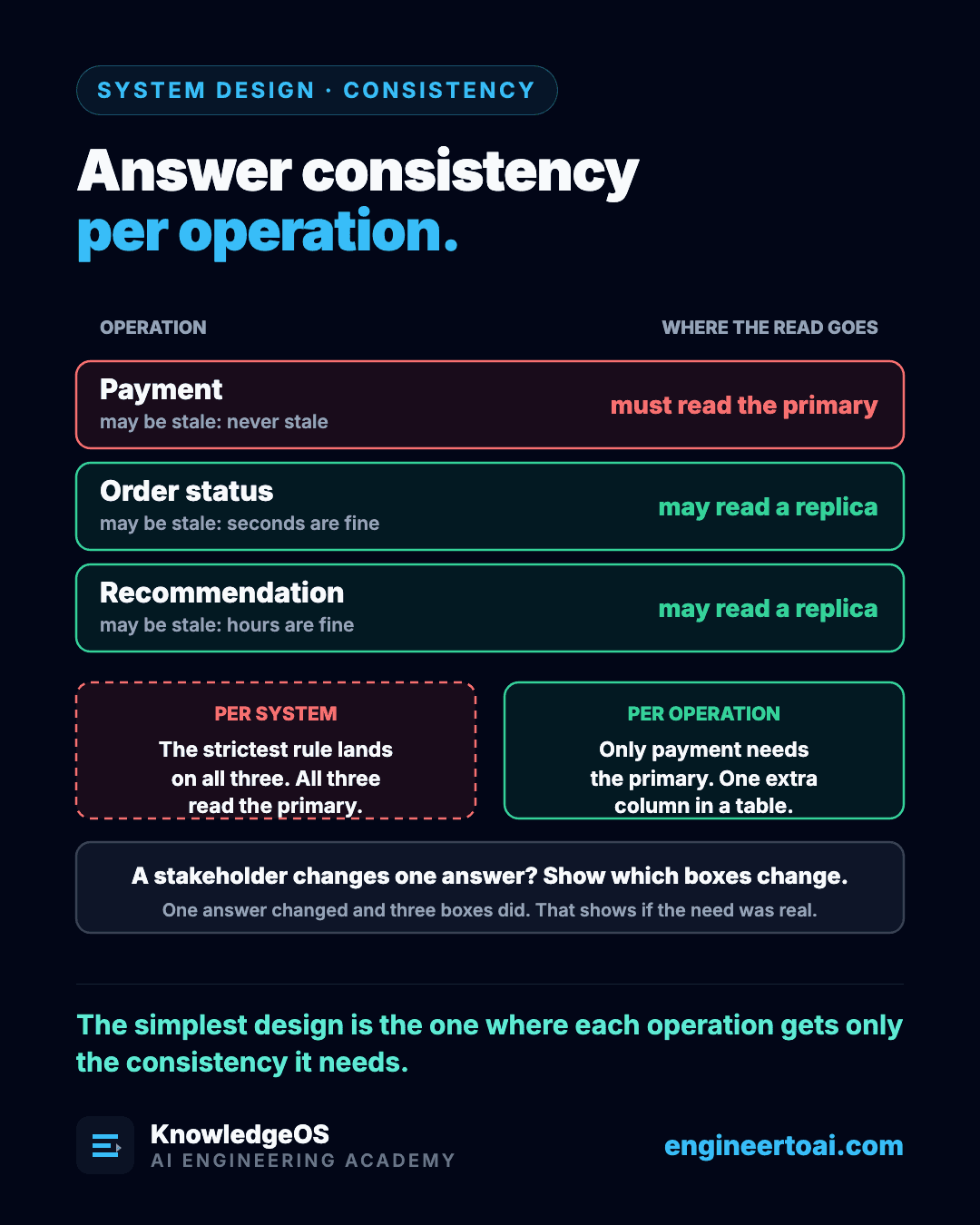
For an order system with three operations that carry the value, the course answers consistency one row at a time:
| Operation | May be stale? | So the read |
|---|---|---|
| Payment | Never | Must go to the primary |
| Order status | Seconds are fine | May go to a replica |
| Recommendation | Hours are fine | May go to a replica |
Why per operation matters
Answering consistency per system forces the strictest operation's requirement onto every operation. A payment's intolerance of staleness ends up applied to order status and recommendations, and you send all three kinds of read to the primary when only one needed it. Answering per operation is, in the course's words, the single largest source of available simplicity in most designs, and it costs one extra column in a table.
The fourth question is its mirror. Designing for the worst failure cost everywhere makes a system expensive without making it reliable: a dropped analytics event and a dropped payment get the same retry logic, the same durability guarantees and the same alerting. Naming the different costs is what lets you spend differently.
The habit to build
Write the answers down before drawing anything, and keep them next to the diagram. Every later disagreement resolves faster when both people can point at the same four lines.
When a stakeholder changes one answer
Suppose someone decides order status must be strongly consistent after all. The course's worked answer: reads move off the replicas onto the primary, so the 40:1 read-to-write ratio now lands on one instance. That either removes the read replicas' purpose or needs a consistent-read mechanism with its own latency cost. The cache in front of reads becomes unusable for status, or needs write-through invalidation, which is itself a consistency problem. And the peak read figure of 13,889 queries a second becomes a primary-database number rather than a fleet number.
One answer changed and three boxes did. Showing that is usually enough to tell whether the requirement was real or reflexive.