Every token you put in front of a model is paid for three times: in money, in latency, and in the model's attention. A bigger context window raises the ceiling. It does not change the job, which on every turn is to send the smallest set of tokens that lets the model answer correctly.
Five lines in the budget
| Budget line | Grows with | Lever |
|---|---|---|
| System prompt | Policy and operating instructions | Keep it precise, versioned, and stable where caching applies |
| Tool schemas | The capabilities exposed in this state | Expose tools per task, or let the agent discover them progressively |
| Conversation state | Raw turns, summaries, persisted facts | Compact it, and retrieve what this decision needs |
| Retrieved context | Number of chunks × chunk size | Rerank so the count stays small and precise |
| Long-term memory | How much is pulled in per turn | Retrieve the few relevant memories, not the whole profile |
Two of these lines are easy to underestimate. In runtimes that send every registered tool on every turn, irrelevant schemas use up input tokens and can make choosing the right tool harder. And replaying every raw turn of a conversation grows without limit unless the application compacts it, summarizes it, or retrieves only the state the current decision needs.
Do the arithmetic before choosing context
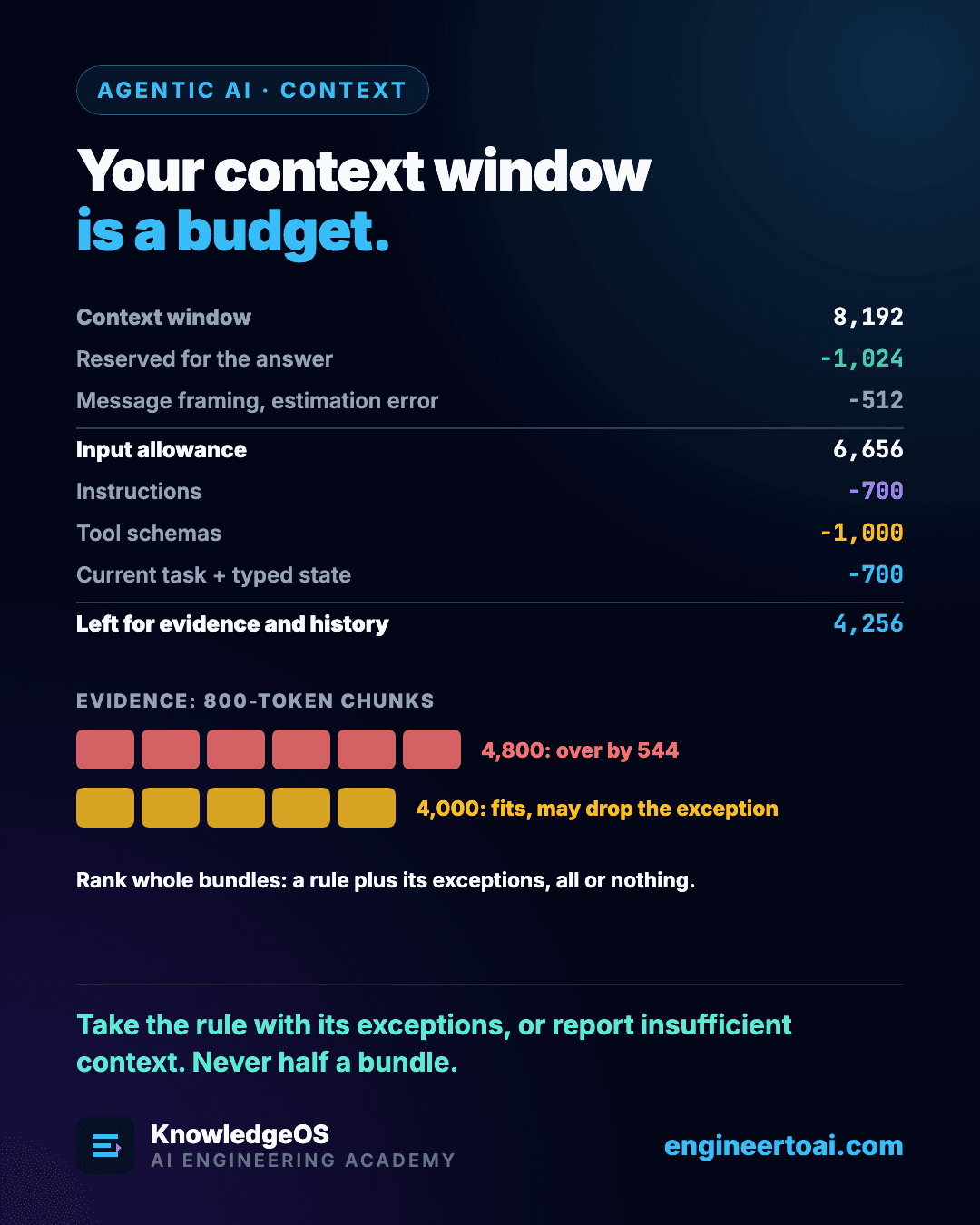
Take a hypothetical 8,192-token window. Reserve 1,024 tokens for the answer and 512 for message framing and estimation error, which leaves an input allowance of 6,656. Instructions take 700, tool schemas 1,000, the current task 200 and typed state 500: 2,400 spent before any evidence, and 4,256 left for evidence and history.
8,192 - 1,024 answer - 512 framing      = 6,656 input allowance
6,656 - (700 + 1,000 + 200 + 500)       = 4,256 for evidence and history

6 chunks x 800 = 4,800   over by 544
5 chunks x 800 = 4,000   fits, with 256 to spare
Use your provider's exact token accounting, including any reasoning or output limits. A rough counter is only an estimate, and the budget is only as good as its numbers.
Common Mistake
Taking the top five chunks because five fit. The sixth may be the exception to a rule stated in the first five, and a prompt that holds the rule without its exception produces a confident, wrong answer. Rank whole evidence bundles, a rule together with its exceptions, and include each bundle completely or not at all. If the bundle the question needs does not fit, report insufficient context rather than answering from part of it.
The principle that makes retrieval work, a handful of highly relevant chunks beating a large dump, applies to the whole session. Every line of the budget competes for the same window.