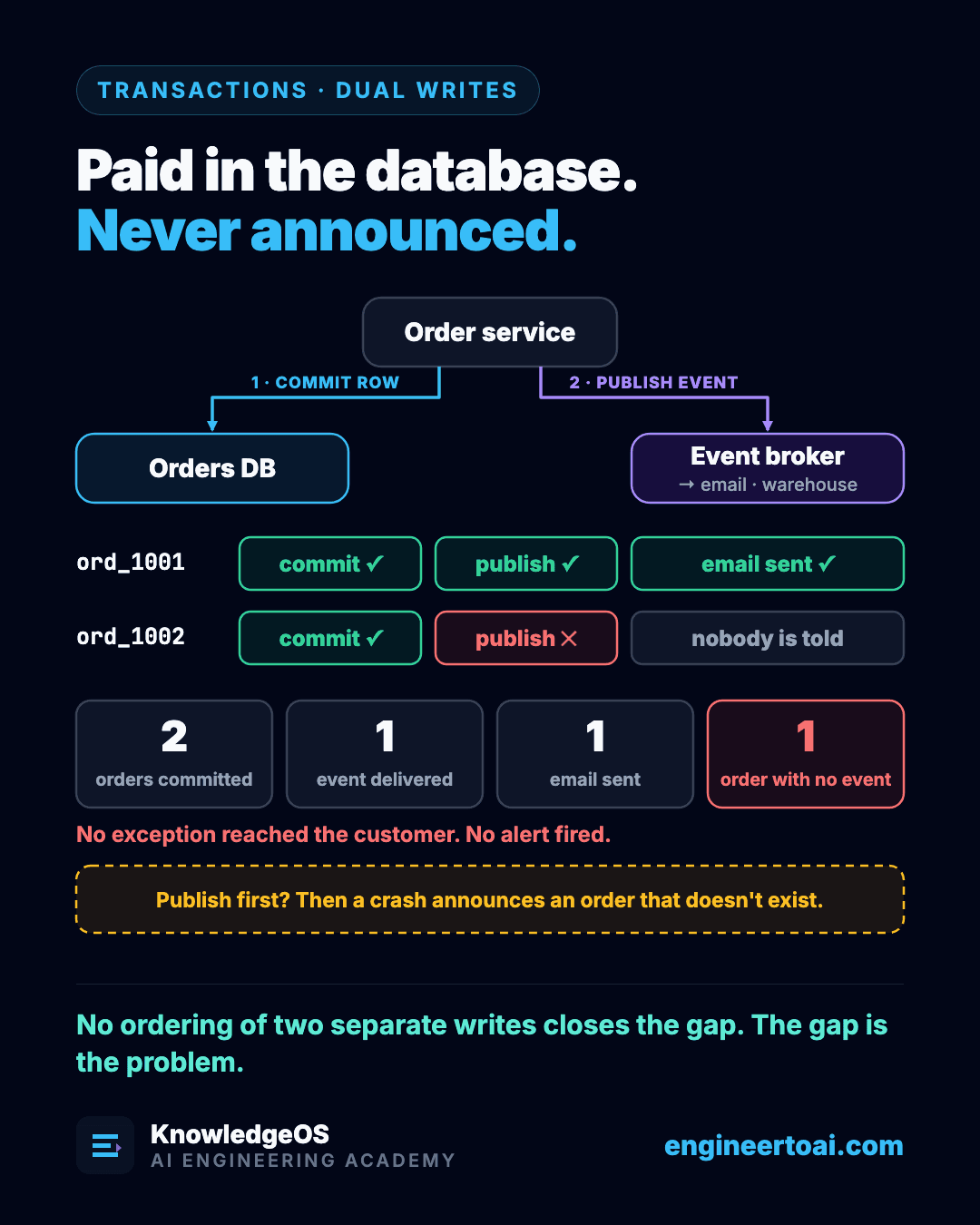
When a customer pays, your order service does two things: it commits the order row, then it publishes an event so the email service can confirm the order and the warehouse can pick it. Two systems, two writes, and no transaction spanning both.
The run
The course's lab, outbox_dual_write.py, does exactly that for two orders:
commit order row for ord_1001
published event for ord_1001
consumer: sends confirmation email for ord_1001
commit order row for ord_1002
publish FAILED for ord_1002 — the row is committed and nobody was told

orders committed    : 2
events delivered    : 1
emails sent         : 1
orders with no event: 1   <- silent drift
ord_1002 is paid in your database and does not exist as far as every downstream system is concerned. No exception reached the customer, and no alert fired. The drift is silent, which is what makes it dangerous: you find it weeks later, when someone asks why a paid order never shipped.
Swapping the order does not help
Publish first and commit second, and a crash in between announces an order that does not exist. There is no ordering of two independent writes that removes the window between them. The window is the problem.
Mental Model
Whenever one action writes to two systems and no transaction spans both, ask what each system believes if the process dies between the two writes. If the answers differ, you have a dual write, and a lucky test run proves nothing about it.
Where the course goes next
The repair is to stop making two independent writes. The course's next section makes the event a row written in the same database transaction as the order, then publishes it from there with a separate relay, so a crash delays the event instead of losing it. That trade has a price the lab makes visible: an event can now be delivered twice, so the consumers that receive it have to deduplicate.