The course's production reference architecture is built on one placement rule: enforce where the protected asset is owned.
The path of a tool call
The edge authenticates the principal, limits the shape and rate of the request, and assigns a trace. An orchestration service builds a typed request, but it does not inherit unlimited service credentials. Retrieval runs authorization before similarity ranking. The model receives minimized evidence and capability descriptions, not raw secrets.
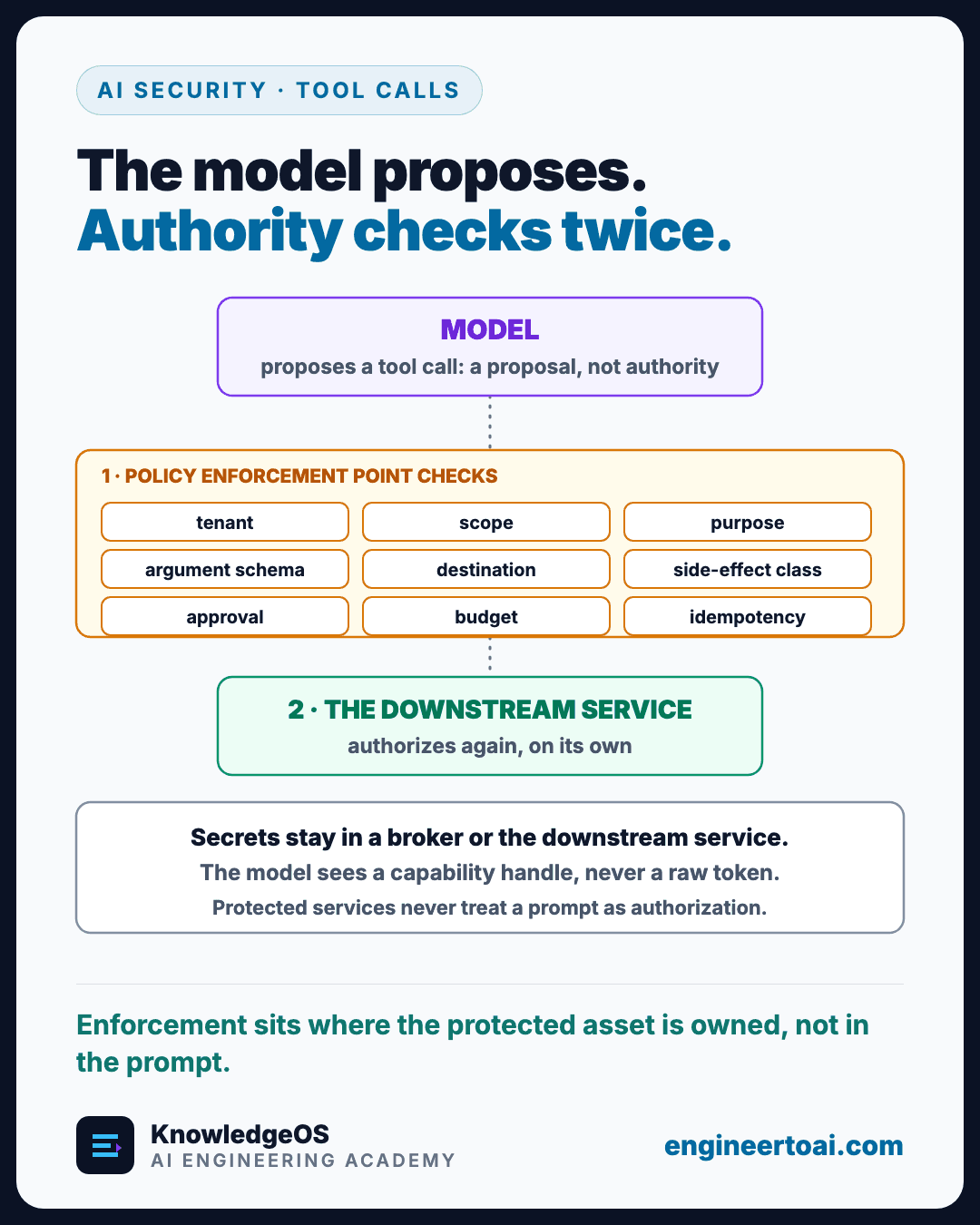
Then the model proposes a tool call, and that call is only a proposal. It passes through a policy enforcement point that checks:
- tenant, scope and purpose;
- the argument schema and the destination;
- the side-effect class and any required approval;
- budget and idempotency.
After that, the downstream service authorizes the call again, on its own terms.
Why twice
Each check has a different owner and knows different things. The policy gate knows the request's context: who is asking, for what purpose, with what approval. The downstream service owns the asset and its rules. The figure's caption says it directly: independent enforcement surrounds the model, and protected services never trust a prompt as authorization.
Common Mistake
Putting the rule in the prompt. Generated arguments are untrusted input, and a prompt is not a permission check. If the only thing between the model and a side effect is an instruction, the instruction is the whole control.
Secrets and the rest of the system
Secrets stay in a broker or in the downstream service, so the model sees a capability handle rather than a raw token. Sandboxes isolate generated code and parsers, and network policy blocks arbitrary destinations. Telemetry records identities, versions, hashes, policy decisions, tool outcomes, cost and safety events while minimizing sensitive content. Kill switches work independently for a model route, a connector, a tool class, a tenant, an ingestion pipeline and the outbound network path.