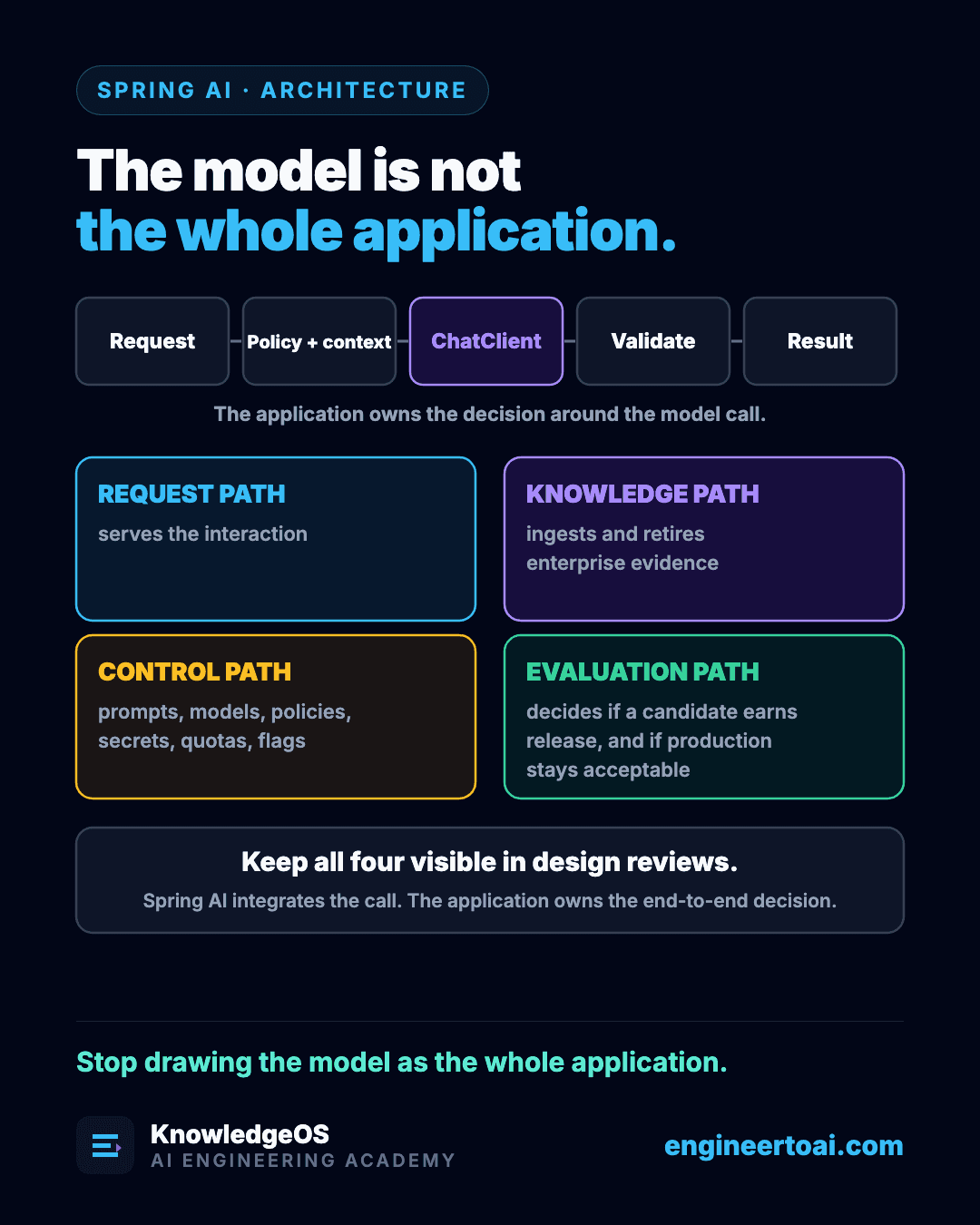
The shortest path to production judgment, in the course's words, is to stop drawing the model as the whole application.
A governed request pipeline
A caller enters through an ordinary transport boundary. The application resolves identity, tenant, role, request purpose and budget. It retrieves only authorized context, chooses an approved prompt and model route, invokes Spring AI, validates the response, enforces post-generation policy and emits evidence.
The model may generate text or request a tool, but deterministic services retain authority over data and side effects. The course's five steps are: resolve the request, apply policy and authorized context, run the ChatClient with approved advisors, model and tools, validate schema and claims, then return the result, abstain or escalate with evidence. Trace IDs, versions, decisions, latency, tokens, citations and outcomes are recorded along the way.
Spring AI integrates the model call. The application owns the end-to-end decision.
Four paths to keep visible
The course asks you to keep four paths visible in design reviews:
- the request path serves the interaction;
- the knowledge path ingests and retires enterprise evidence;
- the control path manages prompts, models, policies, secrets, quotas and feature flags;
- the evaluation path decides whether a candidate deserves release and whether production behavior remains acceptable.
Mental Model
A design review that only draws the request path has drawn the part of the system that is easiest to demo. The other three paths are where evidence goes stale, where behavior changes without a deploy, and where regressions are caught.
A useful question for each review: for every box on the request path, which of the other three paths keeps it correct over time?