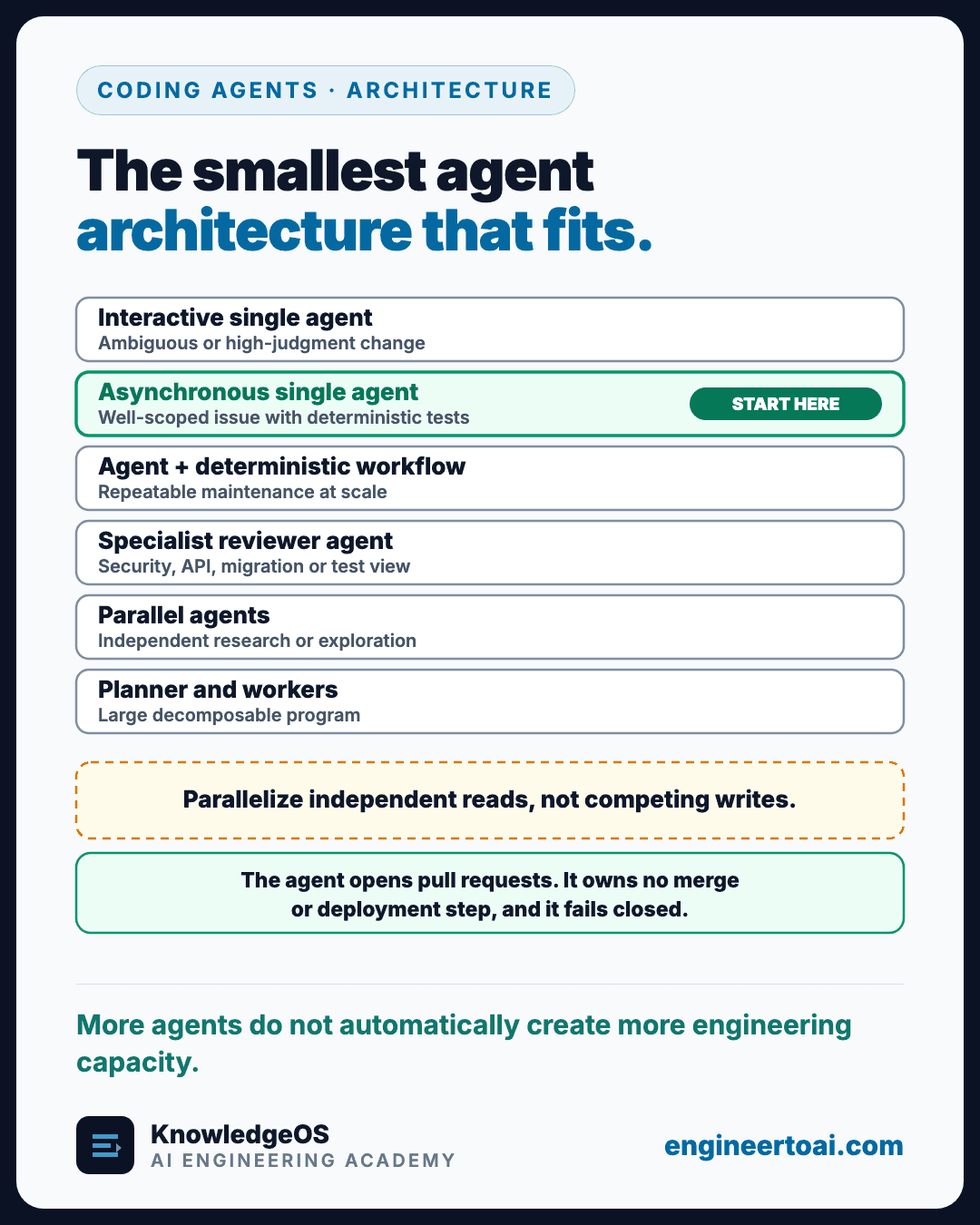
More agents do not automatically create more engineering capacity. The course gives a menu of six patterns, each with a situation it suits and a control concern to watch.
| Pattern | Use when | Control concern |
|---|---|---|
| Interactive single agent | Ambiguous or high-judgment change | Human supervision and checkpoints |
| Asynchronous single agent | Well-scoped issue with deterministic tests | Ephemeral branch, budget, independent CI |
| Agent plus deterministic workflow | Repeatable maintenance at scale | Keep orchestration and gates outside the model |
| Specialist reviewer agent | Security, API, migration or test perspective | Independent context and an explicit rubric |
| Parallel agents | Independent research or candidate exploration | Cost, conflicting edits, synthesis authority |
| Planner and worker hierarchy | Large decomposable program | State, contracts, ownership, integration risk |
Parallelize reads, not writes
Parallelize independent reads and analyses, not competing writes to the same files. For multi-agent work, define artifact contracts: what each worker receives, what it must return, how conflicts are resolved and who owns the final decision. A shared transcript is not a coordination protocol.
A first choice, written down
The table is a menu. A team adopting agents picks one row to start with and records the choice, so the pilot has something to confirm or overturn. The course's decision for the first quarter: well-scoped issues with deterministic tests go to an asynchronous single agent, with one task contract, one ephemeral branch and sandbox, independent CI on the exact commit, and no release authority. Ambiguous or high-consequence changes stay in interactive sessions.
The agent opens pull requests and owns no merge or deployment step. When something goes wrong it fails closed and leaves evidence: a policy denial stops the action until the policy changes outside the session, and the final report says partial, blocked or failed.
Think Like an Engineer
Decide in advance what would change the choice. The course's answer: if defect escape rises along with reviewer effort, that calls for stronger evidence gates, not more agents. Parallel agents, or a planner with workers, wait for work that splits without competing writes to the same files.