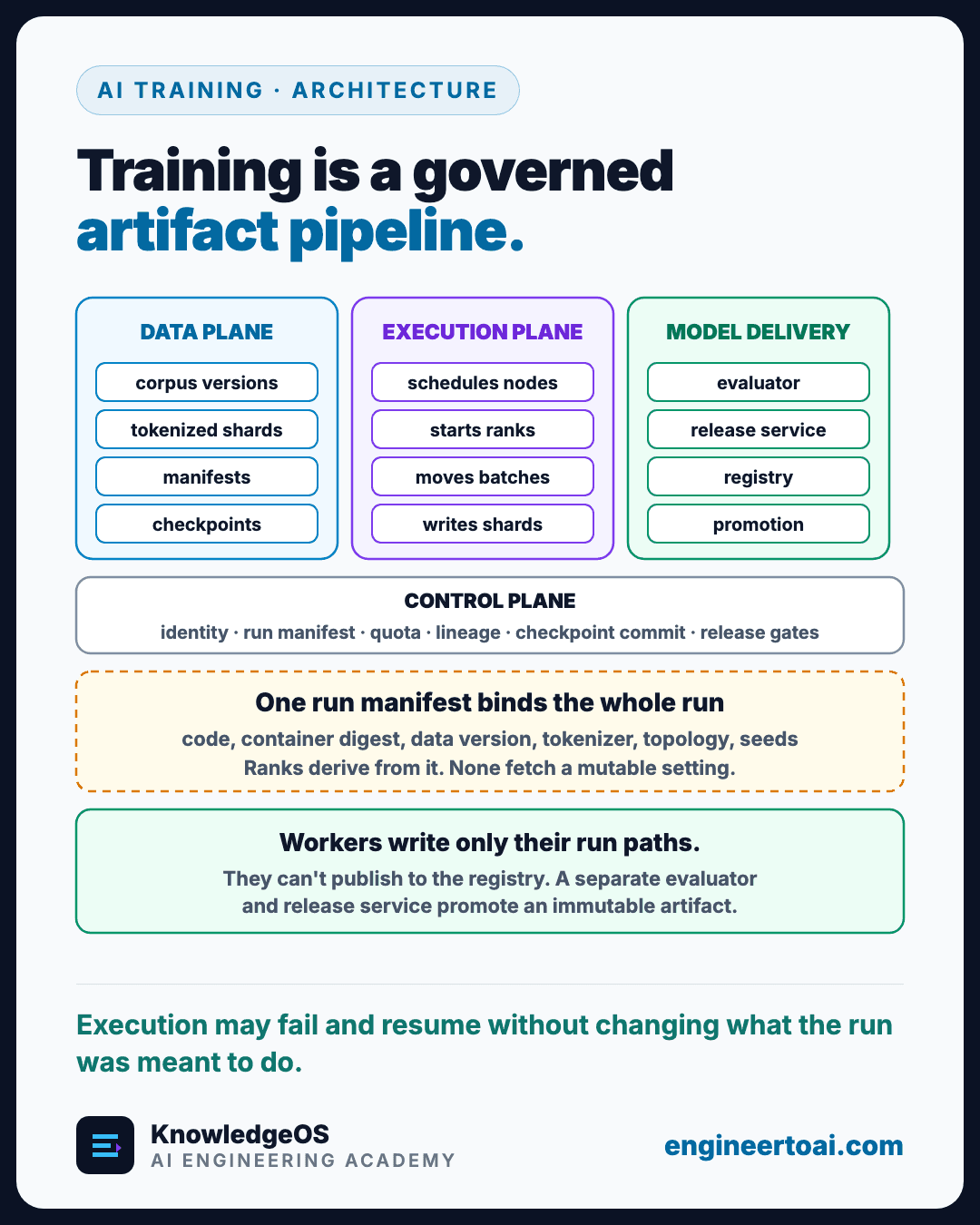
The course's reference architecture makes a plain point: the training script is one participant in a larger artifact-producing system.
Three planes
- The data plane stores governed corpus versions, tokenized shards, indexes and data manifests.
- The execution plane schedules nodes, starts ranks, moves batches, runs kernels and collectives, and writes checkpoint shards.
- The control plane registers experiments, resolves immutable configurations, allocates quota, records lineage, monitors health, coordinates checkpoint commit, evaluates candidates and publishes approved model artifacts.
One manifest for the run
A single run manifest binds source code, container digest, dependencies, hardware, topology, model configuration, tokenizer, data version, sampling mixture, optimizer, precision, parallelism, seeds, checkpoint policy and owner. Rank-local configuration derives from it; ranks do not independently fetch mutable "latest" settings. Outputs land in a run-specific namespace and become visible only through committed manifests.
Mental Model
If two ranks can read different versions of a setting, the run has no single definition. The manifest is what makes "the same run" a checkable claim.
Trust boundaries
Training workers read approved datasets and write only their run paths. They should not publish to the model registry directly. A separate evaluator reads the candidate and sealed evaluation suites, and a release service checks the evidence and promotes an immutable artifact. Operators can stop or retry jobs without changing model code or training data.
The figure's caption sums it up: training is a governed artifact pipeline whose execution plane may fail and resume without changing intent.