Not every product requirement belongs inside model weights. The course describes a production AI system as several adjustable layers:
- the prompt states the immediate task and output expectations;
- retrieval supplies current, private or source-backed facts;
- tools perform exact calculations and authorized actions;
- model routing chooses a capability and cost envelope;
- fine-tuning changes repeated behavior encoded in parameters;
- preference optimization shifts relative choices;
- distillation transfers selected behavior into a different serving model;
- deterministic policy constrains all of them.
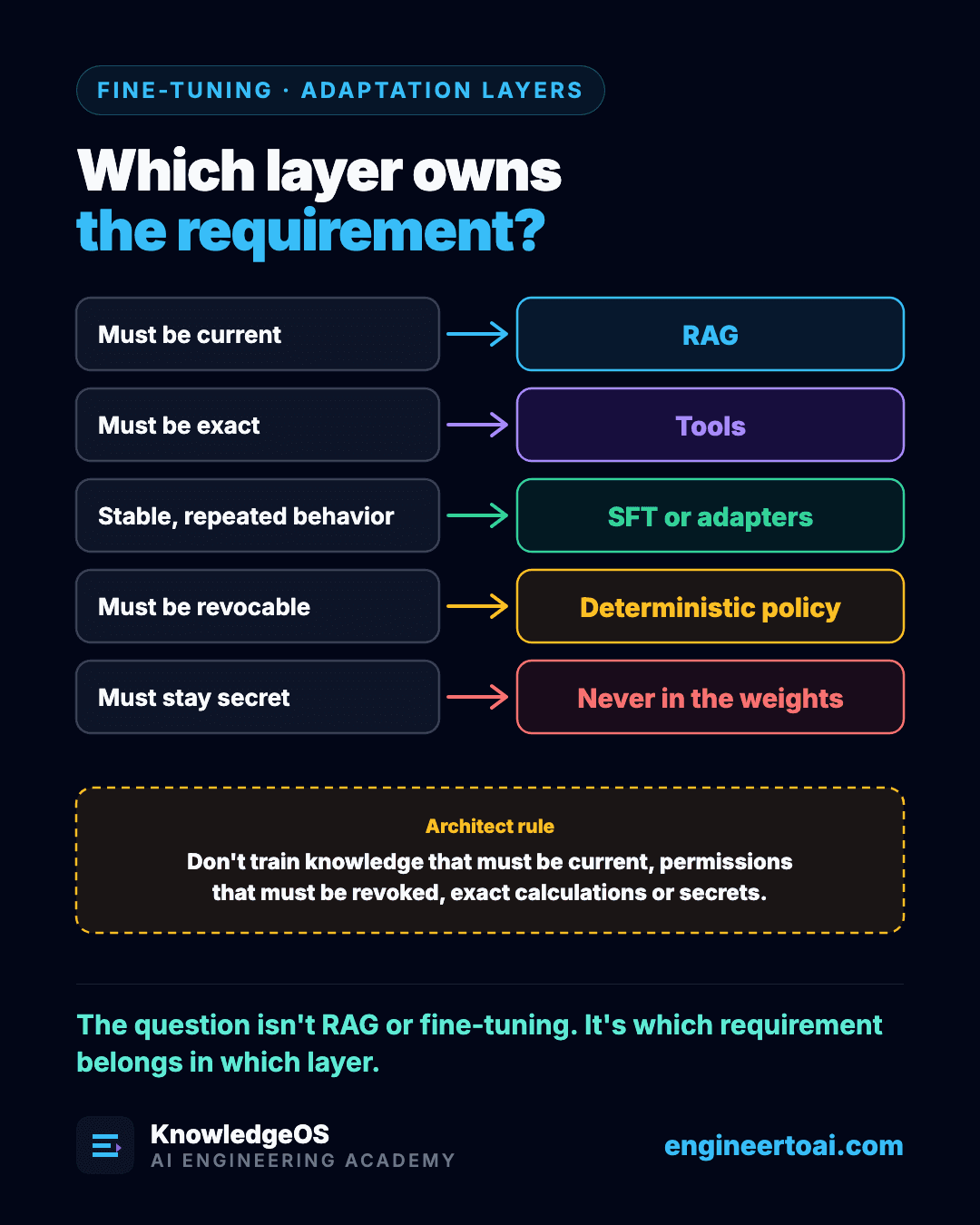
Match the requirement to the layer
| The requirement | The layer that owns it |
|---|---|
| It must be current | Retrieval |
| It must be exact | Tools |
| Stable, repeated behavior | Supervised fine-tuning or adapters, after a measured baseline |
| It must be revocable | Deterministic policy |
| It must stay secret | Nowhere in the weights |
The layers compose. A policy assistant may use RAG for the latest policy text and fine-tuning for a stable answer structure. A support system may use tools for account facts, fine-tuning for classification and preference optimization for response style. Even a distilled model may still need retrieval, because compression does not make its internal knowledge current.
Architect Rule
Do not train knowledge that must be current, permissions that must be revoked, calculations that must be exact, or secrets that should never become parameters.
The better question
The architecture question is not "RAG or fine-tuning?" It is which requirement belongs in which layer, and what evidence validates the composition. Policy and evaluation apply to every layer you choose, and the course's figure notes that these are composable options, not mandatory steps: an application may use prompts and retrieval without any fine-tuning at all.