Three decisions sit in front of every request you make to ChatGPT or Claude: where you ask, which model answers, and how much reasoning you ask it to spend. Developers argue about the second and ignore the first. Yet most disappointing answers come from asking in the wrong place, and most wasted money comes from the other two choices.
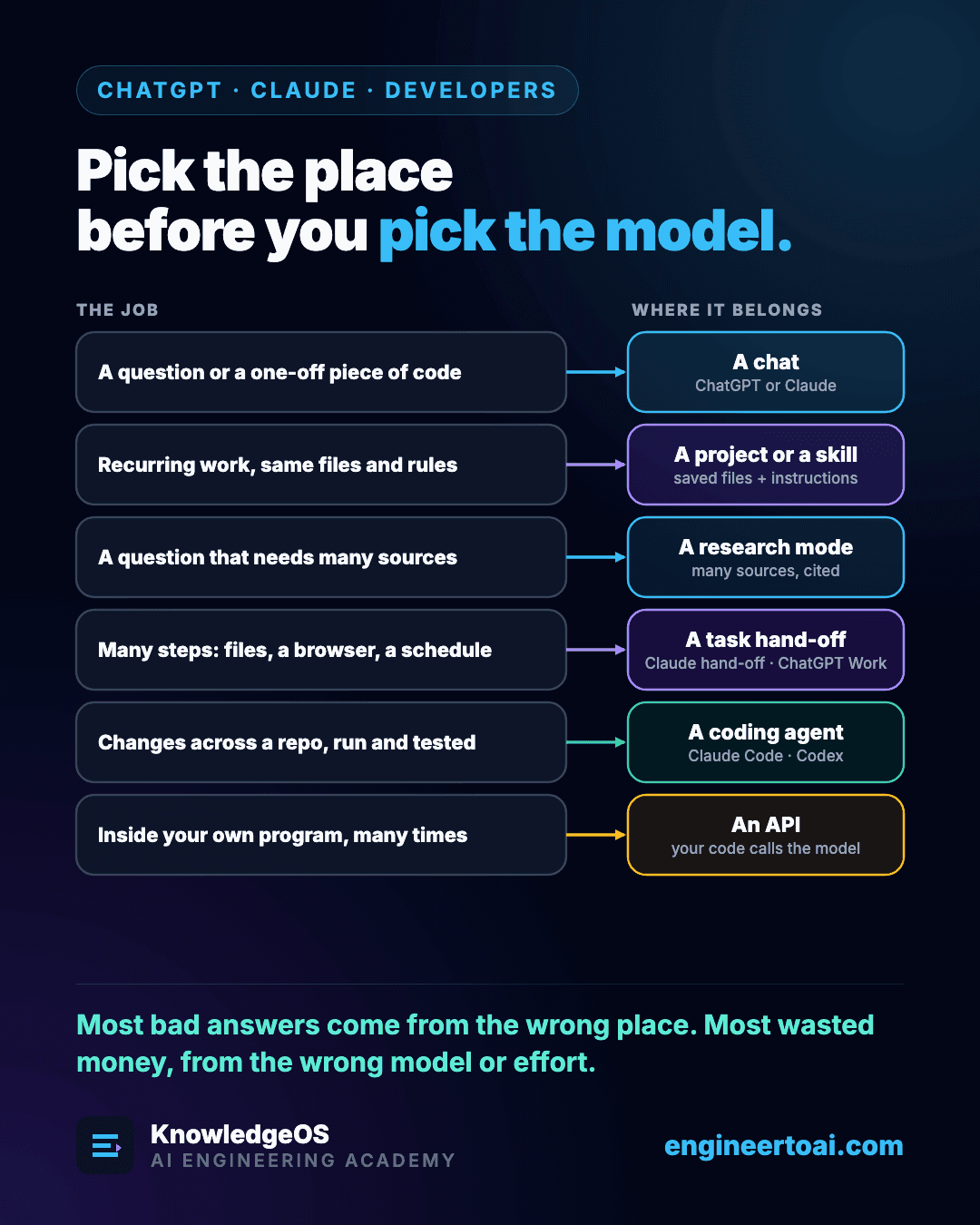
Six jobs, six places
| The job | Where it belongs | Why there |
|---|---|---|
| A question, an explanation or a one-off piece of code | A chat | You check the answer by reading it, so a conversation is enough. |
| Recurring work with the same files and rules | A project or a skill | The context is set up once instead of pasted in every week. |
| A question that needs many sources | A research mode | It gathers and cites sources, and you check the sources. |
| A multi-step task with files, a browser or a schedule | Claude's task hand-off or ChatGPT's Work mode | Built for a finished deliverable rather than a back-and-forth. |
| Changes across a repository that must be run and tested | A coding agent such as Claude Code or Codex | It can run the tests that prove the change works. |
| A task inside your own program, run many times with checked output | An API | Your code controls the input, the output format and the checks. |
The boundaries are soft. A chat can write a whole module, and a coding agent can answer a question. The question that decides it is where the job is cheapest to check. A refactor that touches nine files is cheap to check where the tests can run, and expensive to check by eye in a chat window.
Then change one thing at a time
Once the place is right, start from the mid-tier model at its default effort, and change something only for a reason you can name:
- The answer missed something you supplied, such as a constraint buried in a long file or two facts that interact. Raise the effort, or move up a tier.
- The answer is wrong because it lacked information, such as the file where the bug lives. No model fixes that. Supply the information.
- The task is routine: renaming, reformatting, summarizing. Drop the effort or the tier. You wait less and use less of your allowance.
A stronger model guesses more fluently
Here is the trap the second rule protects you from. An assistant gives a wrong answer about how a search feature builds its query. The instinct is to switch to the biggest model. But if nobody attached the file that builds the query, the assistant was guessing, and a stronger model guesses more convincingly, not more correctly. Supply the evidence, ask again, and only then reach for more reasoning.
Common Mistake
Assuming a ChatGPT or Claude subscription pays for API calls from your own program. The apps are covered by the subscription; the APIs are billed separately, by the token, through an API account. Both carry the same brand name, which is why teams mix them up.
What changes for a team
Before a team debates which model is better, it is worth asking where its AI work happens. Recurring prompts pasted into fresh chats every Monday, repository changes copied out of a chat window and never run, a script calling a chat product instead of an API: each is a placement problem that no model upgrade will solve. Fix the place, then tune the model, then tune the effort, in that order.